Learning to Look
A Foundation for Visual Understanding
1Aalto University 2ELLIS Institute Finland 3University of Oulu
Overview
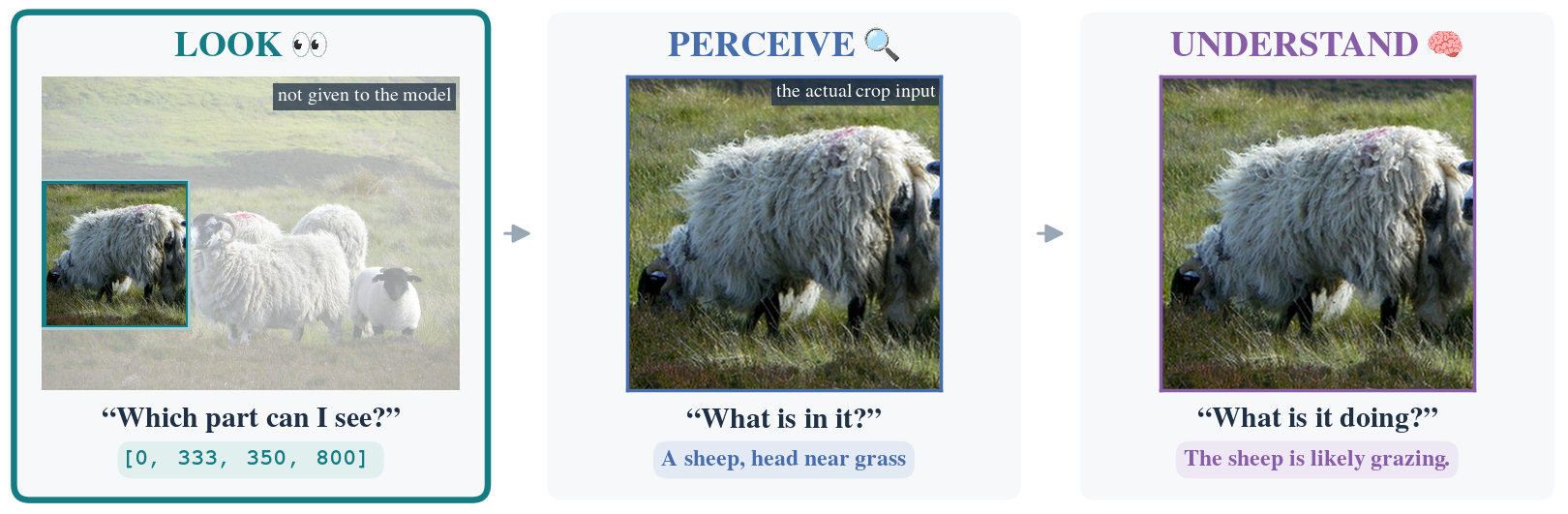
Vision-language models can describe objects that are not present in an image. We ask whether a model knows where it is looking before interpreting what it sees.
We introduce Look, a task in which the model identifies the region of an image available to it. We construct examples by cropping images and retaining the crop’s position information from the full image. The crop coordinates provide supervision without semantic annotation.
Existing VLMs struggle to localize the visible region. Fine-tuning on Look improves localization and visual-input awareness. We also introduce VisABench to measure whether a model’s answers depend on the presence of visual evidence.
The LOOK task
We resize the image to the model’s patch grid, then sample a rectangular crop aligned to complete visual tokens. The model receives only the crop pixels, with positional information inherited from the full image. It predicts the crop’s bounding box in full-image coordinates.
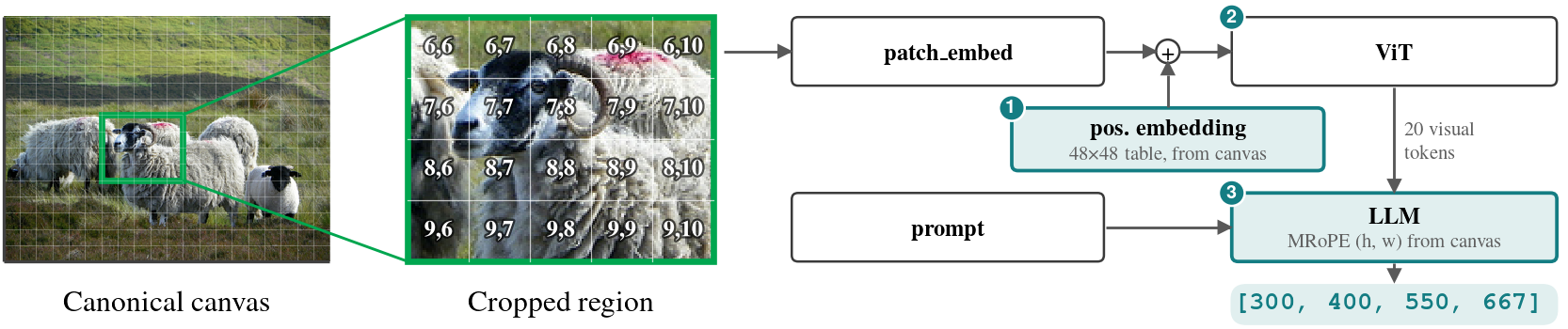
Crop example
Move the crop across the photograph. The model receives the selected pixels and predicts their location within the full image.
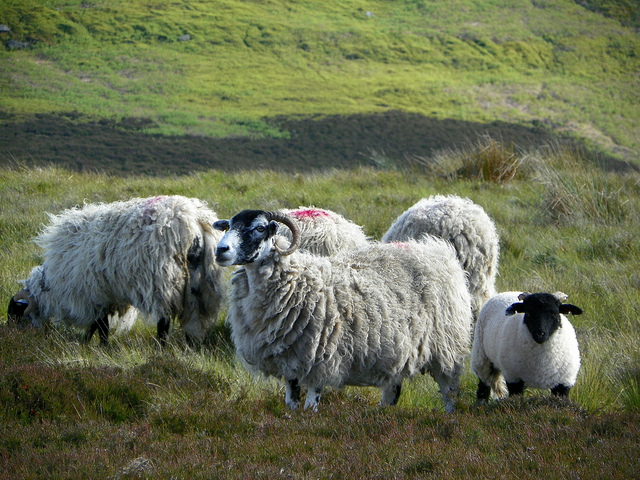
Coordinates are normalized to 0–1000, relative to the full image.
VisABench
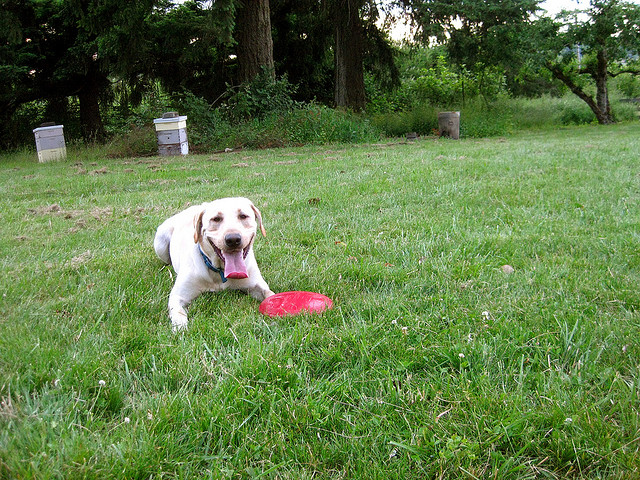
VisABench asks the same object-presence questions under three conditions: the correct image, no visual evidence, and a different image. In the no-evidence condition, visual features are withheld while the input sequence layout is preserved.
Is there a sheep in the image?
Real image
No visual evidence
Different image
Fine-tuning on Look reduces hallucinated object presence when evidence is absent.
| Model | No image | Real image | Different image | Gap ↑ | |||
|---|---|---|---|---|---|---|---|
| Yes (%) ↓ | p(Yes) ↓ | Yes (%) ↑ | p(Yes) ↑ | Yes (%) ↓ | p(Yes) ↓ | ||
| Qwen3-VL-8B-Instruct | 2.5 | 0.041 | 93.3 | 0.927 | 15.6 | 0.158 | 90.7 |
| SFT | 31.2 | 0.409 | 94.9 | 0.915 | 17.0 | 0.196 | 63.7 |
| LocPos | 5.7 | 0.272 | 92.6 | 0.890 | 15.0 | 0.170 | 86.9 |
| Ours (1:10) | 2.3 | 0.202 | 94.1 | 0.910 | 15.7 | 0.183 | 91.8 |
| Ours (2:10) | 4.9 | 0.241 | 93.9 | 0.911 | 16.0 | 0.188 | 89.0 |
| Ours (10:10) | 0.8 | 0.101 | 94.1 | 0.909 | 15.1 | 0.175 | 93.2 |
| Qwen2.5-VL-7B† | — | — | 90.0 | 0.868 | 12.5 | 0.129 | — |
| LLaVA-1.5-7B† | — | — | 95.3 | 0.775 | 30.2 | 0.355 | — |
| Gemma-4-12B | 42.9 | 0.434 | 88.2 | 0.880 | 12.2 | 0.123 | 45.4 |
Gap is the real-image Yes rate minus the no-image Yes rate, in percentage points. † No-image results are omitted for models that produce neither Yes nor No without visual input.
Quick demo
Run two notebooks to inspect visual awareness and compare models on VisABench samples.
- Visual-awareness probes
Compare pixel masks, patch-embedding masks, and crops with reset or restored positions.
- VisABench model comparison
Test Qwen3-VL-8B-Instruct, SFT, LOOK (10:10), Qwen2.5-VL, LLaVA, and Gemma on the same samples.
git clone https://github.com/wenshuaizhao/look.git
cd look
python -m pip install -r requirements.txt -r requirements-notebooks.txt
python -m pip install -e vendor/ms-swift
python -m ipykernel install --user --name look --display-name 'Python (LOOK)'
jupyter lab notebooks
Inference uses a GPU. Set the SFT and LOOK adapter paths in the second notebook; see the setup instructions.
Citation
@misc{zhao2026learningtolook,
  title={Learning to Look: A Foundation for Visual Understanding},
  author={Wenshuai Zhao and Yihao Wang and Benjamin Robson and Juho Kannala and Arno Solin},
  year={2026},
  url={https://github.com/wenshuaizhao/look}
}